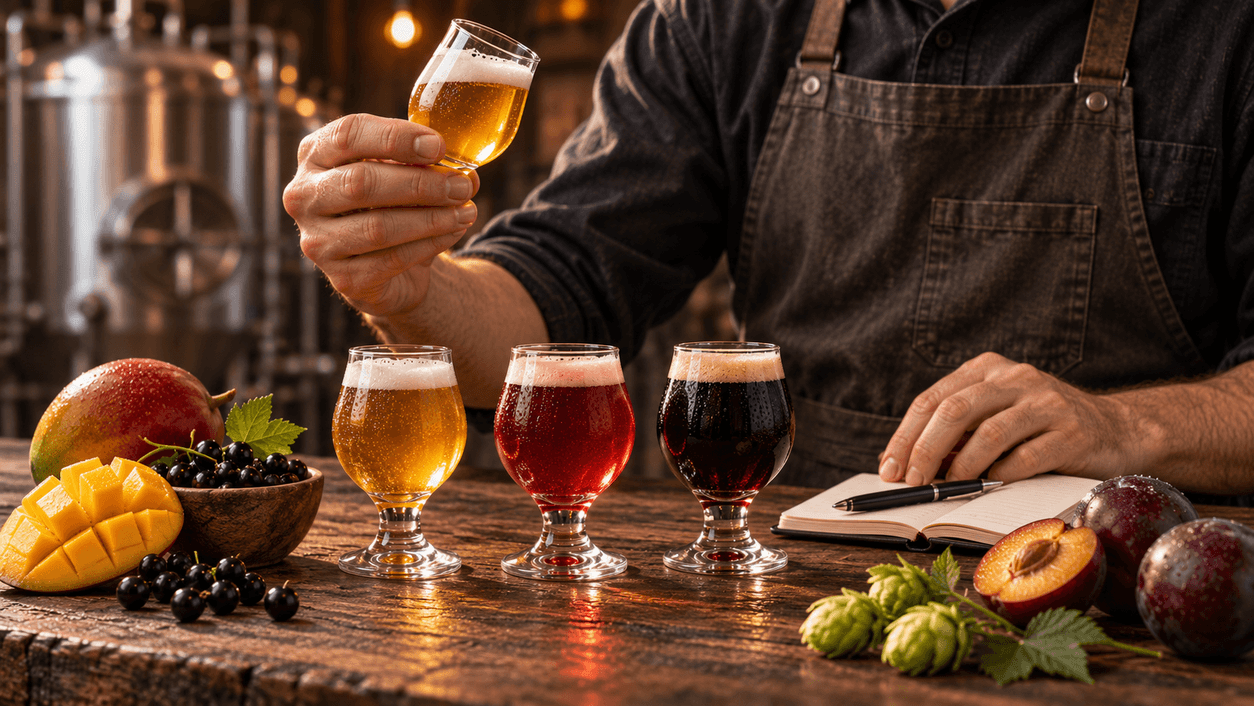
At the end of September, I visited the Gravity Beer Festival at Summerhall in Edinburgh. I tend to approach events like this first and foremost from a brewer’s perspective. Beyond the style name and the list of adjuncts, I look for the decisions behind each beer: why a particular grist was chosen, what the fermentation was intended to achieve, how much room was left for the fruit to shine, and how the beer was balanced as a whole. The festival programme offered plenty of material for comparison, ranging from radlers to dark beers with fruit and barrel-aged projects.
A good starting point is Kyema by Cloudwater. According to the brewery’s description, it is a blend of sour beer aged in wine barrels and a foudre-aged base, refermented on raspberries. The recipe’s very structure offers more to discuss than the simple label of a ‘fruit sour’. There are the proportions of the blend, the character of each component, and the point at which the raspberries are introduced into the overall composition. With a project like this, I would be particularly interested in how the balance evolved during maturation and at what stage the decision was made on the final blend.
Amity Brew Co featured Amethyst Grand Cru, an 8.4% ABV imperial porter with plum. Here, the focus shifts to the relationship between the fruit and the malt. When developing a similar recipe, I would pay particular attention to the proportion of roasted malts, the beer’s final body, and the intensity of the plum character. Each element can work well on its own, yet together they can produce a beer that feels heavy and tiring to drink. What interests me is finding the point at which the fruit becomes clearly identifiable without the porter losing its own identity.
Hand Brew Co took a different approach with Threads – Elderberry Dark Sour. This is a dark sour beer made with elderberries, which the brewery describes as wild-harvested. The combination immediately raises questions of proportion. There is a dark base, acidity and a distinctive fruit ingredient. When assessing a similar beer during recipe trials, I would look at whether these elements come together to form a cohesive flavour profile, and whether the finish remains enjoyable over several successive sips.
In the lighter part of the programme was Pilot’s Pineapple Radler: a hefeweizen-style beer blended with pineapple juice and sugar-free lemonade, at 2.5% ABV. This presents an interesting brewing challenge in its own right. With a combination like this, I would want to establish how much of the base beer’s character survives the blend, and how the sweetness, acidity and carbonation work together. A light recipe demands just as much careful attention to proportions as a strong barrel-aged beer. These examples illustrate why it is difficult to talk about a single approach to ‘adding fruit to beer’. Raspberries in a barrel-aged blend, plums in a porter and pineapple in a radler each serve a very different purpose. Every time, we need to define what we want to achieve and determine how to manage the entire process to get there.
This is the mindset I bring to festival beers. An interesting fruit choice may catch the eye, but the real brewing discussion begins with the details: extract, dosage, timing of the addition, attenuation and time. Before adapting an idea for one of my own recipes, I would run several small-scale trials using the same base beer. I would return to the samples after fermentation and carbonation, when it becomes possible to assess whether the concept genuinely works in the finished beer.