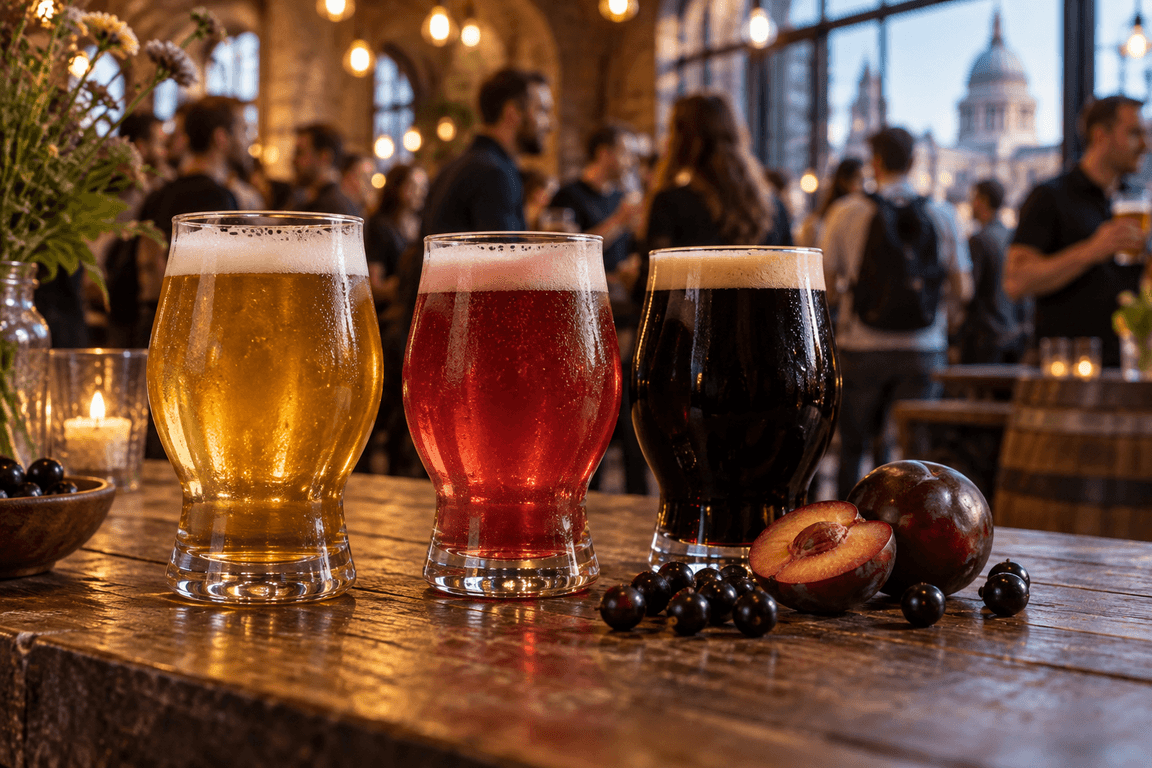
Attending a beer festival in London gave me the opportunity to gain first-hand insight into one of Europe’s most mature craft beer markets. During the industry sessions, I had the chance to speak directly with brewers, brewery owners and professionals responsible for new product development.
Conversations like these offer far more valuable insights than simply observing trends in retail outlets or reading trade publications. At a festival stand, discussions can quickly move beyond evaluating the finished beer to addressing specific production challenges, including ingredient selection, the optimal point of addition, product stability, production costs and the issues that can arise during packaging.
London confirmed that British breweries remain eager to experiment, but they are doing so with an increasingly strategic and disciplined approach.
First: fruit beer is no longer confined to a single style
Fruit featured across a wide range of beer styles. It was no longer reserved solely for sour beers or rich, dessert-inspired brews. Instead, it appeared in highly drinkable session beers, wheat beers, IPAs and darker, fuller-bodied styles.
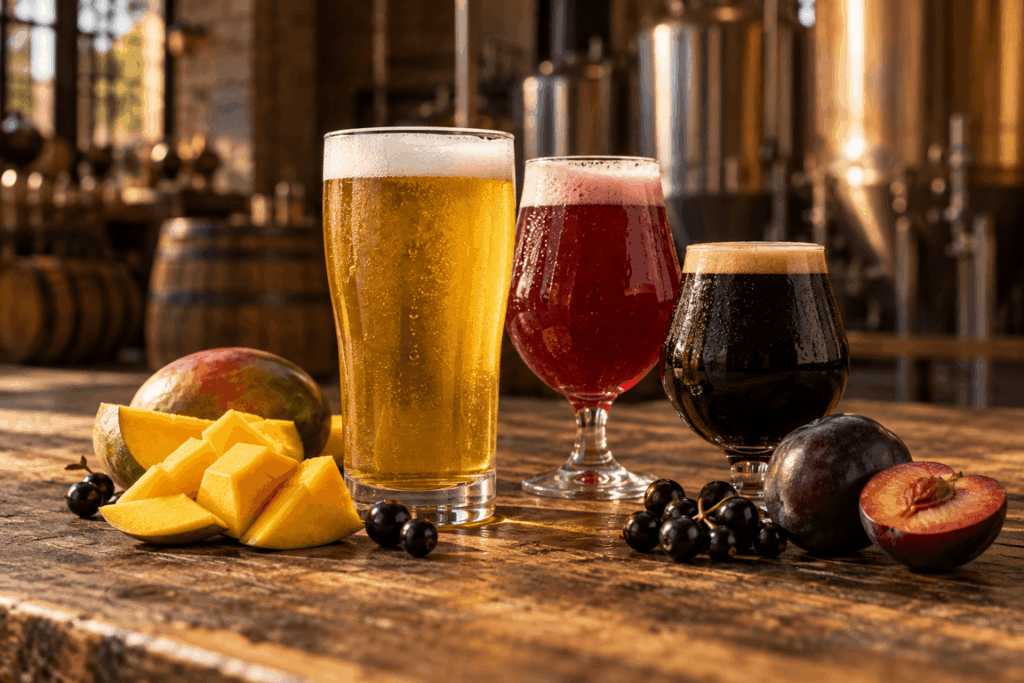
From a recipe development perspective, this is an important observation. There is no single universal approach to incorporating fruit into beer. Mango can complement the tropical hop profile of a beer, but it can just as easily become the defining feature of a sour ale. Blackcurrant works exceptionally well in sour beers, yet at the right dosage it can also create a distinctive flavour profile in darker styles. Similarly, plum pairs naturally with a Baltic porter.
The key is to match the character of the fruit to the chosen beer base. Not every combination that sounds appealing in a product description will perform equally well in the finished beer.
Second: drinkability is back at the forefront
There is still a place in the market for intensely flavoured, full-bodied dessert beers. At the same time, one of the clearest trends I noticed at the London beer festival was the growing presence of lighter, drier beers that are easier to enjoy by the pint.
In beers like these, there is far less room for technical error. In a rich, sweet beer, some imperfections can be masked by a high original gravity and an intense flavour profile. In a lighter beer, every element is exposed.
The fruit character needs to be clearly recognisable, yet it must remain natural and never come across as artificial. Acidity should enhance freshness rather than create an overly sharp or aggressive impression. The aroma should be reflected in the flavour. If a beer delivers an intense mango aroma but the palate reveals little more than sweetness and acidity, the flavour profile lacks balance and completeness.
The best beers were not always the ones that made the biggest impression with the first sip. More often, they were the beers you found yourself wanting to return to once the tasting was over.
Third: stability begins before packaging
One topic that repeatedly came up in conversations with brewers was the stability of fruit beers. Adding fruit juice, concentrate or purée introduces additional sugars, acids, flavour compounds and colour pigments into the beer.
If those sugars remain fermentable, they may trigger renewed fermentation. As a result, the original gravity, alcohol content and carbonation level can all change. In the worst-case scenario, the problem only becomes apparent after packaging, when the product has already reached the distributor or the end customer.
For this reason, the intended role of the fruit sugars should be determined before the fruit is added. Should they be fully fermented, or should they remain as part of the finished beer’s flavour profile? That decision determines when the fruit is added, how the fermentation process is managed afterwards, and which measures are needed to ensure product stability.
Oxygen management is equally important. Oxidation can diminish fresh fruit aromas and alter the beer’s colour. A product that looks perfectly acceptable immediately after blending may become darker, develop brownish tones or lose some of its intensity after a few weeks.
Fourth: a good ingredient must fit the brewery
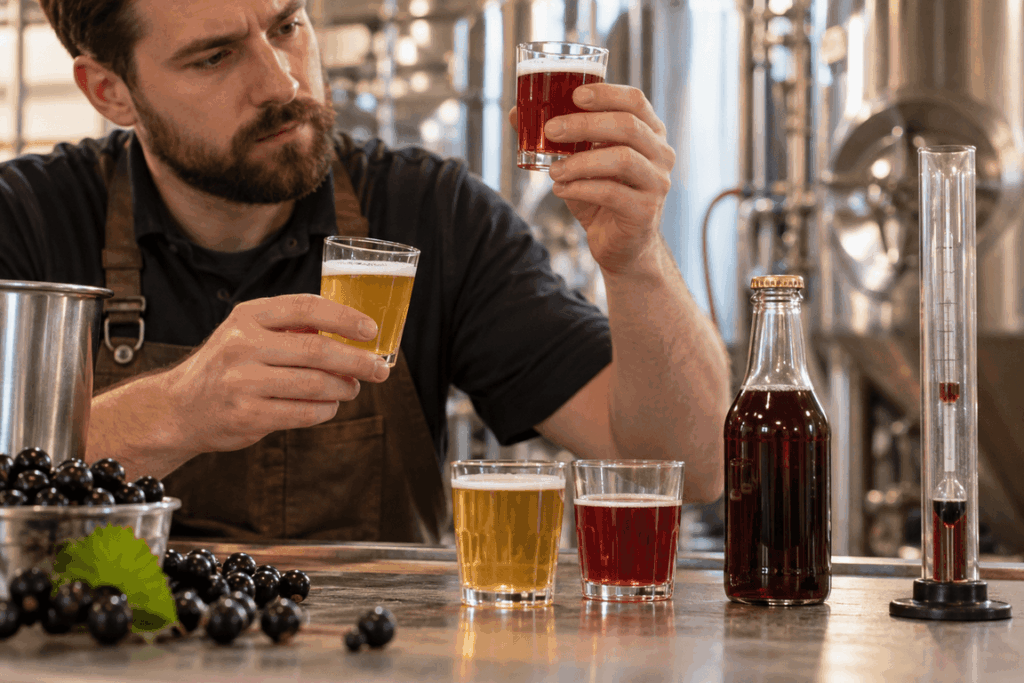
During conversations in London, the discussion quickly moved beyond flavour alone. Brewers were equally interested in ingredient availability, pack size, the opportunity to carry out pilot trials, lead times and batch-to-batch consistency.
This is entirely understandable. Even the most impressive ingredient from a sensory perspective is of little practical value if it is difficult to pump from its container, disperse evenly in the tank or source consistently in the required volumes.
Water content is another important consideration. When larger volumes of NFC (Not From Concentrate) juice are added, a brewery may inadvertently dilute the beer base prepared earlier in the process. By contrast, a concentrated fruit ingredient delivers more natural extract and flavour while adding significantly less volume to the tank.
This does not mean that fruit concentrate is always the right choice. Fruit purée may be the preferred option when the desired outcome is a distinctive mouthfeel or texture. Juice, on the other hand, can be an excellent solution when only a modest addition is required. The choice of fruit format should be guided by the intended sensory outcome and the requirements of the brewing process, rather than by the name of the fruit itself.
What did I take away from London?
For me, the greatest value of the festival lay in the opportunity to speak directly with the people responsible for day-to-day brewing operations. British breweries continue to look for new and distinctive flavour profiles, but they are placing increasing emphasis on production efficiency, supply chain reliability and maintaining consistent quality from batch to batch.
A great beer concept must be reproducible not only in the laboratory, but also at full production scale. The fruit ingredient must integrate seamlessly with the beer base, minimise processing losses and retain its intended sensory profile throughout the product’s shelf life.
London also reinforced an important point: technology does not limit creativity. On the contrary, the better we understand our ingredients and the brewing process, the more confidently we can develop bold new beers without compromising quality or consistency.
I returned from the festival with new contacts and fresh ideas, but above all with the conviction that the future of fruit beer lies in recipes that combine distinctive character with exceptional drinkability, long-term stability and a carefully engineered brewing process.