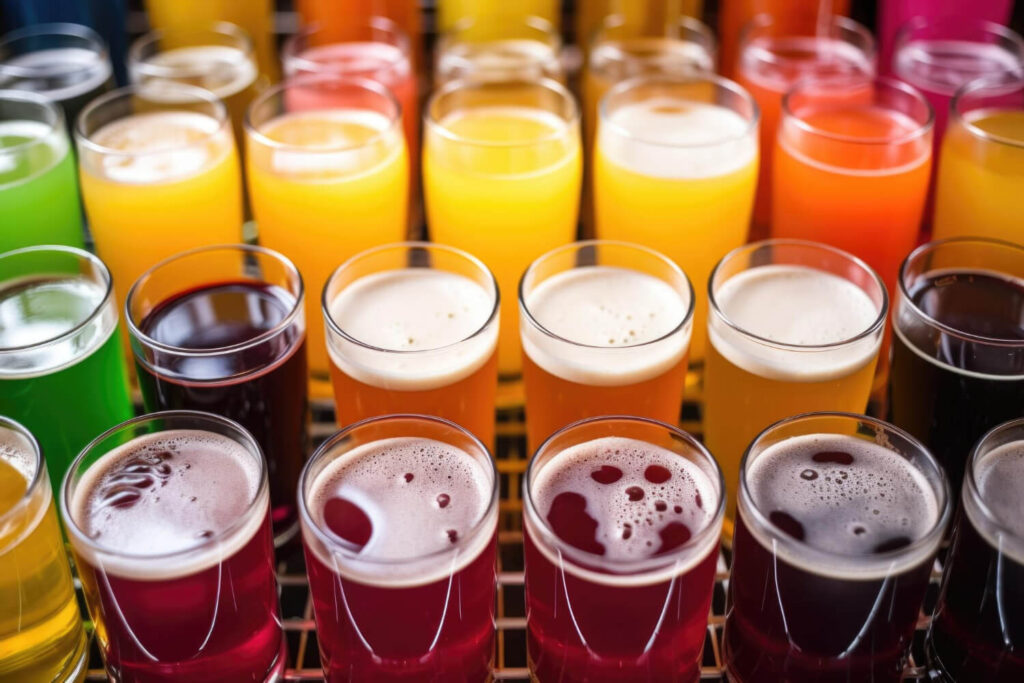
The fruit beer category, encompassing styles such as fruit beer, pastry sour, and fruit variants of wheat beers, is currently experiencing a period of dynamic growth. The contemporary consumer has become highly discerning and demanding, seeking authenticity, natural composition, and a rich sensory profile, while rejecting products based on synthetic flavourings. For brewers, this necessitates the selection of raw materials that not only deliver flavour but also ensure microbiological stability and batch-to-batch consistency.
The Evolution of the Fruit Beer Market – Challenges for Contemporary Brewing
The principal technological dilemma centres on the choice of fruit base: NFC juice (Not From Concentrate) or concentrated juice. Although both originate from natural sources, their impact on the fermentation process, logistics, and the final cost of beer production differs fundamentally. A thorough understanding of the physicochemical properties of these raw materials is key to optimising production in the modern brewery.
What characterises NFC juices in the beer production process?
NFC juices are produced by the direct pressing of fresh fruit and are typically subjected to mild pasteurisation thereafter.
Their defining feature is the retention of their natural water content (often exceeding 85–90%), which makes them ideal for direct consumption, yet challenging in industrial applications.
Technological risks and limitations of NFC juices
The use of NFC juices in brewing is associated with significant constraints. The primary issue is the so-called dilution effect. Introducing large volumes of water contained in NFC juice into the fermentation vessel substantially reduces the wort extract level as well as the final alcohol content (ABV). To achieve an intense flavour using NFC juice, the brewer must introduce a substantial volume of liquid, which often results in a beer perceived as ‘watery’, lacking the desired body and texture.
A further challenge is the lack of consistency. The parameters of NFC juices (acidity, sugar content) vary depending on the batch of fruit and the season. For a brewery striving for product standardisation, this represents a significant risk, potentially leading to flavour variations between individual batches of the same beer.
Concentrated juices – stability, precision and flavour retention
In professional brewing, the use of concentrated juices is increasingly becoming the standard. Their production process is based on the evaporation of water under controlled conditions, resulting in a highly concentrated raw material.
Contrary to earlier assumptions, this process does not strip the fruit of its aromatic profile. In modern evaporation systems, aroma recovery from vapours and its immediate reintegration into the final product is an integral stage of the process. As a result, concentrated juice retains the full, natural aromatic profile of the fruit from which it is derived, while simultaneously offering a high density of nutrients and colour compounds.
Why are concentrated juices the standard in professional brewing?
Precision in raw material selection allows for full control over the brewing process. The use of concentrated juice at a level of 70.5 °Brix ensures that only the most valuable components are introduced into the beer – namely concentrated fermentable sugars and a deep organoleptic profile. Such a degree of concentration enables precise calculation of the final extract without the risk of uncontrolled dilution of the product.
Key advantages of using fruit concentrates in beer production
The choice of fruit concentrates over NFC juices offers a range of benefits that optimise brewery operations across multiple dimensions :
- Preservation of beer structure (no dilution): The removal of excess water at the juice production stage enables the brewer to introduce intense flavour and colour without compromising the beer’s body or alcohol content.
- Consistency assurance: Concentrated juices are standardised products. Stable Brix and acidity parameters enable precise recipe formulation and ensure that every can or bottle leaving the brewery delivers a consistent flavour profile.
- Superior microbiological purity: The high density and osmotic pressure of concentrated juice naturally inhibit the growth of most microorganisms. This makes the raw material safer to use and less susceptible to contamination than juices with a high water content.
- Logistical and storage efficiency: Concentrate occupies only a fraction of the volume of NFC juice. This translates into a substantial reduction in transport costs (as there is no need to pay for shipping water) as well as significant savings in cold storage and warehouse space.
- Speed and ease of application: The low volume of the raw material facilitates dosing into fermentation vessels, reducing processing time and minimising the risk of errors during production.
- Consistent raw material availability: Thanks to the extended shelf life of concentrates, breweries can produce their flagship fruit beers year-round, regardless of harvest seasonality, while maintaining stable pricing and consistent product quality.
The myth of the sensory superiority of NFC juices – technological facts
The commonly held belief that NFC (Not From Concentrate) juices impart a ‘fresher’ profile in beer is not supported by modern technological understanding. During fermentation, yeast metabolises the sugars present in fruit. What is critical to the final outcome are stable colour compounds and the recovery of aromatic compounds. Concentrated juices, due to their greater intensity and richness, often produce a more pronounced and persistent ‘juiciness’ effect in the finished beer, which does not fade after several weeks of maturation.
Summary – process optimisation in brewing using concentrated juices
From the perspective of a brewing technologist, concentrated juice is a more precise and economically justified tool. It enables the production of beers with an intense fruit profile while maintaining full control over extract levels and microbiological stability. Although NFC juices are valuable in the beverage segment, within a professional brewery environment they are generally superseded by concentrates, which offer uncompromising quality, consistency and logistical efficiency. For the modern craft brewery, the choice of concentrated juices represents an investment in stable growth and the satisfaction of loyal consumers.