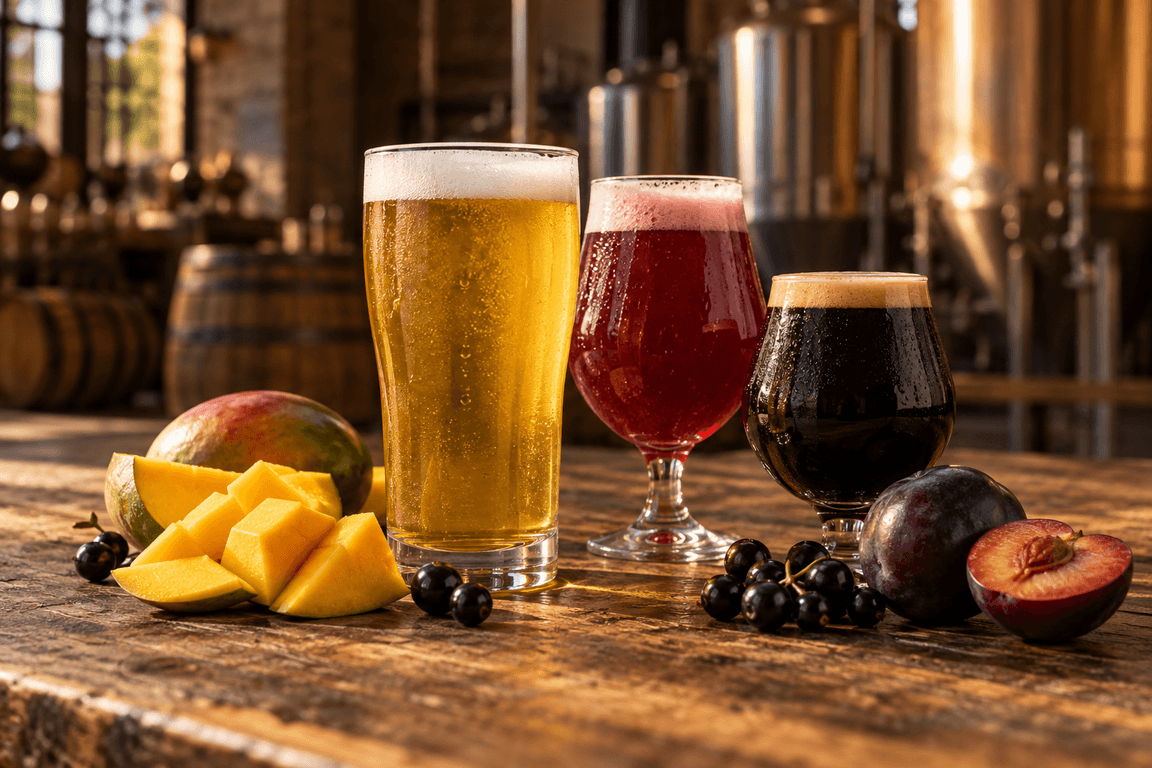
Attending an industry beer festival in Barcelona gave me the opportunity to compare my day-to-day work as a brewing technologist with what breweries across Europe are currently looking for. At events like these, I am interested in far more than simply tasting finished beers. I pay close attention to recipe design, the way fruit ingredients are incorporated, flavour balance, and the production challenges that may arise further down the line.
Barcelona showed that breweries are still eager to experiment, but are becoming increasingly focused on controlling costs, reducing production losses and achieving greater consistency from their raw materials. A good idea on its own is no longer enough. It also has to be translated into successive production batches while maintaining consistent flavour, aroma and appearance.
First: fruit should be an integral part of the recipe
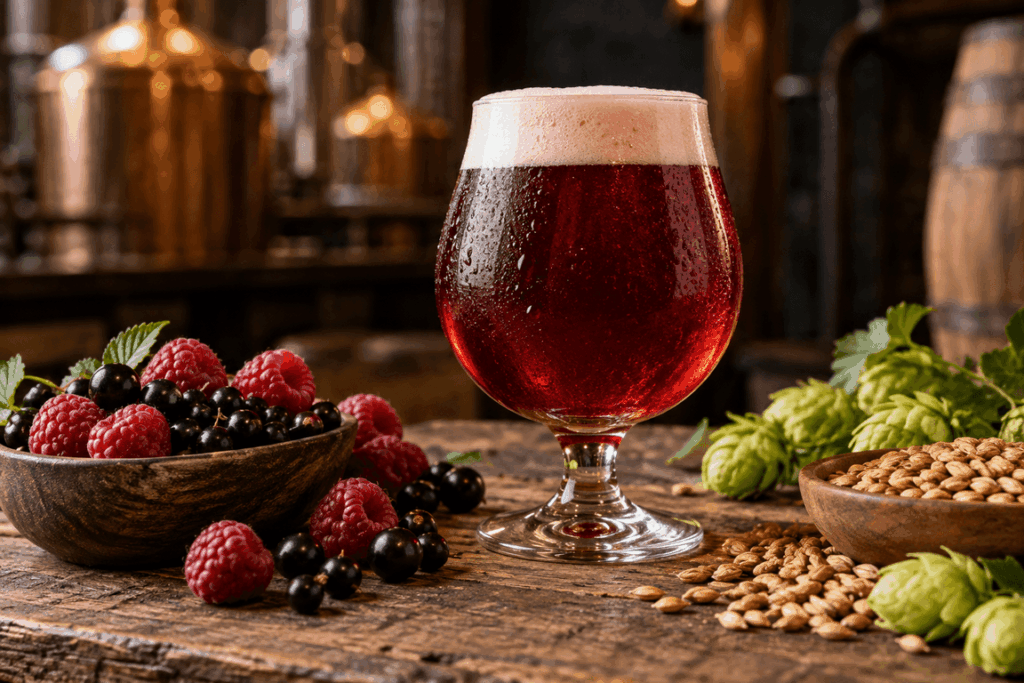
One of the key takeaways from the festival was that fruit should not be treated as a finishing addition used simply to make a beer more appealing. The best beers had been designed from the outset around a clearly defined fruit profile.
The grain bill, degree of attenuation, yeast strain, hopping regime and acidity all need to create the right foundation for the fruit. If the beer base is too dominant, the fruit character can easily become lost. If the beer base is too neutral, the finished product begins to resemble a fruit drink with only a small proportion of beer.
A well-crafted fruit beer should work as a cohesive whole. The fruit may lead the sensory profile, but the underlying characteristics derived from the malt, fermentation and hops should still remain clearly perceptible.
Second: intensity should never come at the expense of balance
The festival featured many beers that were intensely flavoured, sweet and highly aromatic. Products like these attract attention quickly, particularly on the first tasting. From a brewing technologist’s perspective, however, the more important question is whether the beer remains drinkable after several sips.
A higher fruit dosage does not necessarily produce a better beer. If a large amount of sugar is introduced along with the fruit without sufficient acidity to balance it, the finished beer can become heavy and cloying. Conversely, excessive acid adjustment can completely mask the fruit’s natural character.
The most impressive beers achieved their impact through balance rather than intensity. The aroma was pronounced, the fruit flavour remained clearly recognisable, yet the finish was neither overly sweet nor aggressively acidic. It is this level of precision that determines whether a consumer enjoys a full serving or sets the glass aside after just a few sips.
Third: the form of the fruit ingredient matters
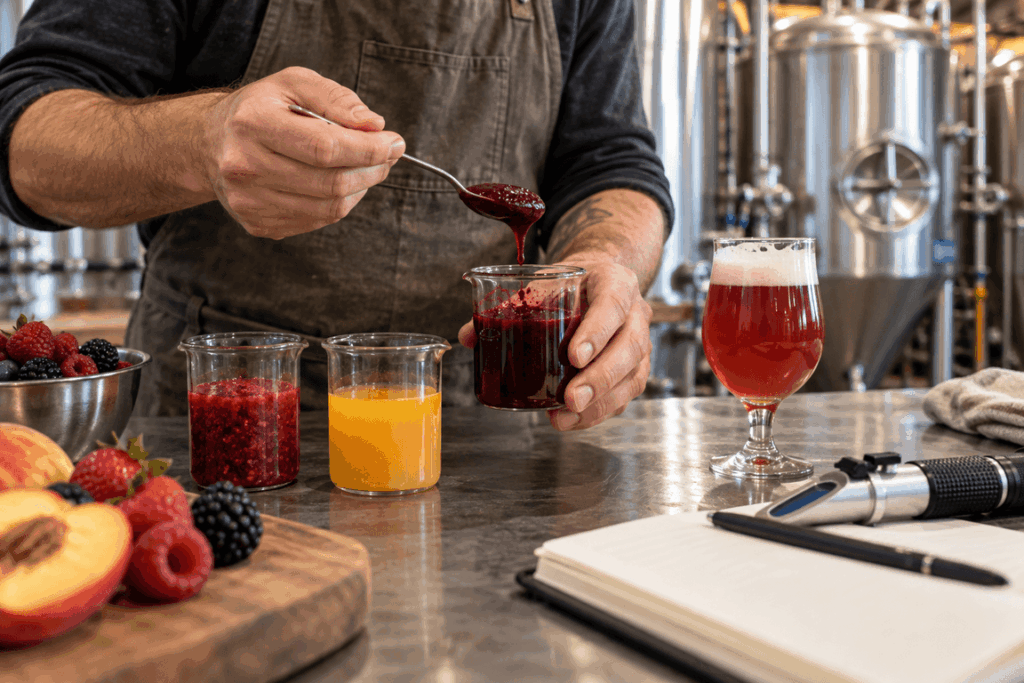
Conversations with brewers confirmed that the choice between fresh fruit, fruit purée, NFC juice and fruit concentrate should not be based solely on the desired flavour profile. Each of these forms behaves differently during production.
Fruit purée can introduce a significant amount of pulp, increasing product losses during transfer. NFC juice is easy to use, but it also adds a considerable amount of water to the tank. At higher dosing rates, this can reduce the original gravity and dilute the beer base prepared earlier in the process.
Fruit concentrate makes it possible to introduce both flavour and natural extract while adding considerably less volume. Fruit concentrate is easier to transport and store, but it also requires a thorough understanding of its key characteristics. A brewing technologist should monitor, above all, its Brix value, acidity, pH and fermentable sugar content, as these can trigger renewed fermentation.
There is no single fruit ingredient that is suitable for every beer. What matters is selecting the right ingredient for the recipe, the point at which it is added, and the capabilities of the specific brewing system.
Fourth: Consistency becomes part of quality
With a one-off brew, minor variations between batches of fruit can be regarded as part of the beer’s artisanal character. The situation changes once the product becomes a permanent part of the portfolio or is distributed through retail channels.
Each subsequent batch must maintain a consistent colour, aroma, original gravity and acidity. Simply adding the same number of kilograms of fruit to every brew is no longer sufficient. The first step is to understand the characteristics of the current fruit batch and define the desired outcome in the finished beer.
This requires trials, measurements and adjustments. It is good practice to prepare several dosing scenarios and then evaluate not only the fresh sample, but also how the beer develops after a few days or even weeks. Colour and aroma may change during storage, particularly when exposed to oxygen, light and temperature fluctuations.
What have I taken away from Barcelona?
Barcelona showed me a market that remains open to bold and innovative flavours, yet is becoming increasingly less tolerant of improvised solutions. Breweries want to stand out, but they also need ingredients that are easy to incorporate into production, deliver consistent results and fit seamlessly into real-world brewing operations.
For brewers, this means combining creativity with rigorous process control. Whether using an unusual fruit, an unconventional spice or a carefully balanced combination of complementary ingredients, every component must serve a clear purpose.
For me, the festival was more than just a source of fresh inspiration. Above all, it reinforced the idea that, in modern brewing, great flavour begins long before the beer is poured for tasting. It starts with understanding the raw materials, designing the process carefully, and anticipating how the finished product will perform long after it has left the brewery.